
Device
Garmin Cirqa Review: Screenless Fitness Tracker Worth It?
Garmin Cirqa Review: Screenless Fitness Tracker Worth It?

Most fitness trackers treat the display as a core feature. Garmin's new Cirqa smart band takes a different approach entirely.
The Garmin Cirqa is a screenless wearable fitness tracker priced at $199. There's no screen to glance at, no buttons to press mid-run. You wear it, it collects your health data all day, and you check your stats later in the Garmin Connect app. That's the whole philosophy.
It's a bold bet from a company that built its name on feature-packed GPS watches. But there's a real market for this kind of device: people who already wear a watch they love, people who want something lighter than an Apple Watch, and people who are tired of subscription-based trackers like Whoop that charge you $288 per year before you've seen a single data point.
In this review, we cover everything you need to know about the Garmin Cirqa: what it tracks, how it compares to the competition, who it's actually built for, and whether the $199 price makes sense for your situation.
Key Takeaways
The Garmin Cirqa is a $199 screenless smart band with 10-day battery life, 80+ auto-detected sport types, and no required subscription.
It tracks continuous heart rate, HRV, sleep, stress, SpO2, and skin temperature, with all data living in the free Garmin Connect app.
No GPS, no ECG, and no screen by design. If you want live stats on your wrist, this isn't the right tracker.
Garmin Cirqa Specs at a Glance
Price: $199 USD; optional bicep band $59
Battery life: Up to 10 days
Weight: 20g
Water resistance: 50 meters
Connectivity: Bluetooth, ANT+
Display: None (screenless)
GPS: None
Sensor: Garmin Gen4 optical heart rate
Subscription: None required; Connect+ at $10.99/month optional
Design and Build
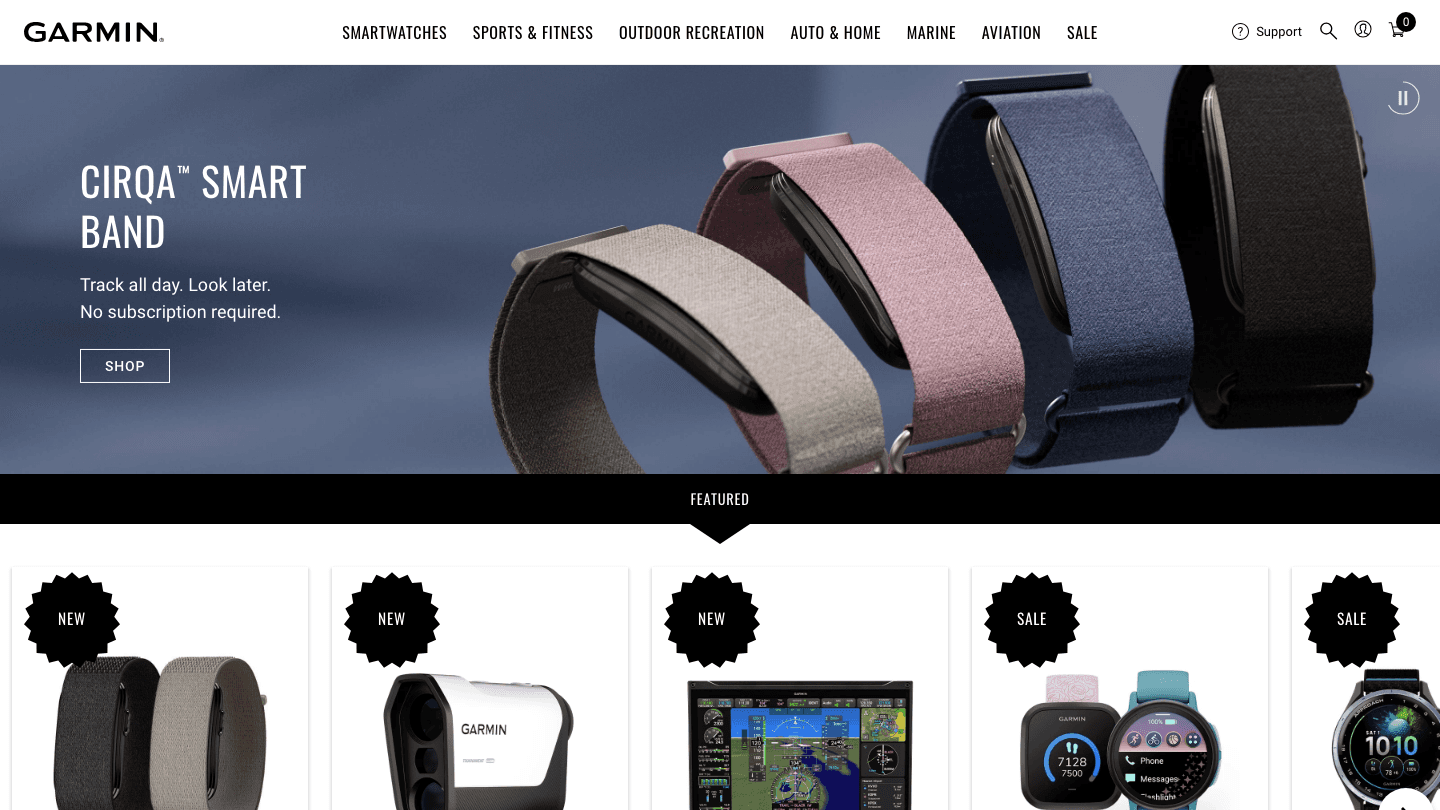
The Cirqa looks more like a bracelet than a fitness tracker. Without a screen or visible buttons, it's the kind of device you can wear alongside a mechanical watch without drawing attention. Garmin offers it in two sizes and multiple band colors, giving it a bit of range across different wrist sizes and personal styles.
At 20 grams, it's light enough to forget you're wearing it. The silicone band sits close to the skin for accurate optical readings, and 50-meter water resistance means you can wear it swimming or in the shower without a second thought. The optional bicep band ($59) lets you use the sensor during activities where wrist placement gets in the way.
The one real tradeoff of the screenless design: you can't see anything on the device itself. No vibration for step goals, no notification mirror, no quick glance at your heart rate mid-workout. You check all of that in the app afterward. For some people, that constraint is the whole point. For others, it's a dealbreaker before they even try it.
What the Garmin Cirqa Tracks
The Cirqa's sensor suite is genuinely solid for a $199 device. It reads continuous heart rate, blood oxygen saturation (SpO2), respiration rate, heart rate variability, skin temperature, and stress levels throughout the day. These aren't just raw numbers. Garmin's algorithms layer them into actionable metrics.
Training Readiness is the headline metric: a daily score that combines sleep quality, HRV status, recovery time, and acute load to tell you whether your body is ready for a hard workout or needs a lighter day. Acute Load tracks the cumulative effort of your recent training across a rolling window. Both are the same metrics found on Garmin's Fenix and Forerunner watches, which is a notable value add at this price point.
For HRV specifically, understanding your personal baseline is where real insight lives. Check out our guide to heart rate variability by age and what counts as a healthy range, and our breakdown of rMSSD and other HRV metrics to understand exactly how Garmin calculates its HRV Status score.
Workout and Activity Tracking
The Cirqa auto-detects over 80 sport types, including running, cycling, swimming, strength training, and yoga. You don't need to manually start a session. The band identifies the activity and starts logging. After your workout, the data syncs to Garmin Connect, where you'll see duration, heart rate zones, estimated calories, and a Recovery Time estimate.
The missing piece is GPS. Distance and pace during outdoor runs come from your paired phone's GPS (if you bring it), not an onboard sensor. If you regularly run without your phone or need precise route mapping, you'll want a GPS watch instead. For strength training, group fitness, cycling, and swimming, the absence of GPS doesn't matter at all.
We've covered the best activity tracking apps and how different wearables handle workout detection, and the Cirqa's auto-detection is one of the more reliable implementations at this price point.
Sleep and Recovery Tracking
Sleep is where the Cirqa earns its price. It tracks sleep stages (light, deep, REM), total duration, respiration rate, HRV, and average SpO2 throughout the night. The Health Status dashboard surfaces trends over 7, 28, and 90-day windows so you can see whether your sleep patterns are improving or declining over time.
Garmin also includes Women's Health features: menstrual cycle tracking with skin temperature monitoring, which can detect subtle physiological shifts that purely optical trackers miss entirely.
For anyone building better sleep habits, pairing the Cirqa's data with solid strategies is where real payoff starts. Our guide to the best sleep tracking apps breaks down how to make sleep data actionable rather than just informative. And if you want to understand what your recovery score is actually telling you, that breakdown explains the underlying logic.
The Garmin Connect App Experience
The Cirqa's interface lives entirely in Garmin Connect, a free app for iOS and Android. The app has been around for years, and the design is dense and data-forward, which suits serious athletes who want every metric but can feel like a lot if you're new to fitness tracking.
The customizable dashboard lets you pin the metrics you care about most (Training Readiness, steps, sleep score, stress) to an "Essentials" section at the top. Garmin also supports data sync with third-party services including Strava and TrainingPeaks, which matters if you're already logging workouts elsewhere.
For a full overview of what you can do with Garmin data beyond the default app, our guide to the best apps to use with Garmin covers syncing strategies, third-party integrations, and how to turn raw data into better training decisions. And if the Garmin Body Battery score has ever confused you, that guide explains exactly how the algorithm works and what the numbers mean in practice.
The Garmin Connect+ Subscription
For $10.99 per month, Garmin's Connect+ tier adds structured workouts, nutrition tracking, and a live activity view that shows real-time heart rate and metrics during exercise. The key word is optional. All core health tracking (HRV, sleep, Training Readiness, workout auto-detection) works without paying anything beyond the device price.
That said, the live activity dashboard restriction is worth flagging before you buy. Without Connect+, you can't see real-time heart rate on your phone during a workout. It's a frustrating limitation for a device whose entire value is in the data it collects. If real-time heart rate monitoring matters to you, factor $10.99/month into your total cost of ownership.
Where the Garmin Cirqa Falls Short
No GPS onboard. Route tracking and pace data require your phone.
No ECG. The Gen4 optical sensor doesn't support electrocardiogram readings.
No screen. You can't check your heart rate mid-workout without opening the app.
Live dashboard gated behind Connect+. Real-time stats cost $10.99/month extra.
Proprietary charging cable. Yet another cable to keep track of.
Who Should Buy the Garmin Cirqa
The Cirqa makes the most sense for a few specific people. If you're already in the Garmin ecosystem, the training metrics will feel familiar and the Garmin Connect integration fits naturally. If you wear a watch you love and want a separate health tracker that doesn't look like a tech accessory, the Cirqa's bracelet-style design fits that need cleanly.
It's also a meaningful alternative to subscription-based trackers. Whoop's cheapest plan runs around $16/month, which totals $192 per year before device costs. The Cirqa is $199 upfront with no recurring fees, making the total cost of ownership substantially lower over 12 months. That said, Whoop offers stronger athlete-focused coaching features and a cleaner app experience for dedicated athletes.
For a full comparison of how different wearables stack up, our guide to which wearable device is right for you covers Apple Watch, Whoop, Oura, Garmin, Fitbit, and Ultrahuman side by side. If you want to know whether the Cirqa holds up in the pool, check our breakdown of Garmin waterproofing ratings.
Pairing the Garmin Cirqa with Lifestack
The Cirqa is good at collecting health data. What you do with that data is where most people leave potential untouched.
Lifestack is a scheduling app built around energy awareness. It syncs with your wearable data and uses your recovery signals, sleep quality, and energy patterns to help you plan your day around how you actually feel, not just around when meetings happen to land. If your Training Readiness is low after a rough night, Lifestack surfaces that context when you're planning your morning, so you can protect focused work for when you have the capacity for it.
For anyone using the Cirqa to take sleep and recovery seriously, pairing it with a tool that adjusts your schedule around that data is the natural next step. See how the best apps work alongside Garmin to turn health data into better daily decisions, or read our introduction to Lifestack to see how energy-aware scheduling works. Lifestack costs $7/month or $50/year, with a 7-day free trial on the annual plan.
Frequently Asked Questions
Does the Garmin Cirqa have a screen?
No. The Garmin Cirqa is a screenless device by design. All data is viewed through the Garmin Connect app on your phone. There's no display, no vibration alerts, and no buttons to press during a workout.
Does the Garmin Cirqa have GPS?
No, the Cirqa does not have onboard GPS. For outdoor activities where distance and pace matter, it relies on your paired smartphone's GPS signal. For indoor workouts, swimming, and strength training, the lack of GPS is not a limitation.
Is a subscription required for the Garmin Cirqa?
No subscription is required. All core health tracking (sleep, HRV, Training Readiness, workout auto-detection) works with the free Garmin Connect app. The optional Garmin Connect+ subscription at $10.99/month adds structured workouts, nutrition tracking, and real-time heart rate viewing during exercise.
How long does the Garmin Cirqa battery last?
Garmin claims up to 10 days. In practice, 7 to 10 days between charges is realistic for most users depending on how frequently SpO2 readings are taken and how often the device syncs to your phone.
Is the Garmin Cirqa waterproof?
Yes, the Garmin Cirqa is rated to 50 meters water resistance, making it suitable for swimming and everyday showering. For more detail on how Garmin's waterproofing ratings work across devices, see our guide to Garmin waterproofing.
How does the Garmin Cirqa compare to Whoop?
The Cirqa costs $199 upfront with no required subscription. Whoop requires a monthly subscription (starting around $16/month), which covers the device cost. Over 12 months, the Cirqa is typically less expensive. Whoop offers stronger athlete-focused coaching features, while the Cirqa benefits from Garmin's broader ecosystem and training metrics like Training Readiness and Acute Load. Neither has GPS or ECG. See our full wearable comparison guide for a deeper breakdown.
Most fitness trackers treat the display as a core feature. Garmin's new Cirqa smart band takes a different approach entirely.
The Garmin Cirqa is a screenless wearable fitness tracker priced at $199. There's no screen to glance at, no buttons to press mid-run. You wear it, it collects your health data all day, and you check your stats later in the Garmin Connect app. That's the whole philosophy.
It's a bold bet from a company that built its name on feature-packed GPS watches. But there's a real market for this kind of device: people who already wear a watch they love, people who want something lighter than an Apple Watch, and people who are tired of subscription-based trackers like Whoop that charge you $288 per year before you've seen a single data point.
In this review, we cover everything you need to know about the Garmin Cirqa: what it tracks, how it compares to the competition, who it's actually built for, and whether the $199 price makes sense for your situation.
Key Takeaways
The Garmin Cirqa is a $199 screenless smart band with 10-day battery life, 80+ auto-detected sport types, and no required subscription.
It tracks continuous heart rate, HRV, sleep, stress, SpO2, and skin temperature, with all data living in the free Garmin Connect app.
No GPS, no ECG, and no screen by design. If you want live stats on your wrist, this isn't the right tracker.
Garmin Cirqa Specs at a Glance
Price: $199 USD; optional bicep band $59
Battery life: Up to 10 days
Weight: 20g
Water resistance: 50 meters
Connectivity: Bluetooth, ANT+
Display: None (screenless)
GPS: None
Sensor: Garmin Gen4 optical heart rate
Subscription: None required; Connect+ at $10.99/month optional
Design and Build
The Cirqa looks more like a bracelet than a fitness tracker. Without a screen or visible buttons, it's the kind of device you can wear alongside a mechanical watch without drawing attention. Garmin offers it in two sizes and multiple band colors, giving it a bit of range across different wrist sizes and personal styles.
At 20 grams, it's light enough to forget you're wearing it. The silicone band sits close to the skin for accurate optical readings, and 50-meter water resistance means you can wear it swimming or in the shower without a second thought. The optional bicep band ($59) lets you use the sensor during activities where wrist placement gets in the way.
The one real tradeoff of the screenless design: you can't see anything on the device itself. No vibration for step goals, no notification mirror, no quick glance at your heart rate mid-workout. You check all of that in the app afterward. For some people, that constraint is the whole point. For others, it's a dealbreaker before they even try it.
What the Garmin Cirqa Tracks
The Cirqa's sensor suite is genuinely solid for a $199 device. It reads continuous heart rate, blood oxygen saturation (SpO2), respiration rate, heart rate variability, skin temperature, and stress levels throughout the day. These aren't just raw numbers. Garmin's algorithms layer them into actionable metrics.
Training Readiness is the headline metric: a daily score that combines sleep quality, HRV status, recovery time, and acute load to tell you whether your body is ready for a hard workout or needs a lighter day. Acute Load tracks the cumulative effort of your recent training across a rolling window. Both are the same metrics found on Garmin's Fenix and Forerunner watches, which is a notable value add at this price point.
For HRV specifically, understanding your personal baseline is where real insight lives. Check out our guide to heart rate variability by age and what counts as a healthy range, and our breakdown of rMSSD and other HRV metrics to understand exactly how Garmin calculates its HRV Status score.
Workout and Activity Tracking
The Cirqa auto-detects over 80 sport types, including running, cycling, swimming, strength training, and yoga. You don't need to manually start a session. The band identifies the activity and starts logging. After your workout, the data syncs to Garmin Connect, where you'll see duration, heart rate zones, estimated calories, and a Recovery Time estimate.
The missing piece is GPS. Distance and pace during outdoor runs come from your paired phone's GPS (if you bring it), not an onboard sensor. If you regularly run without your phone or need precise route mapping, you'll want a GPS watch instead. For strength training, group fitness, cycling, and swimming, the absence of GPS doesn't matter at all.
We've covered the best activity tracking apps and how different wearables handle workout detection, and the Cirqa's auto-detection is one of the more reliable implementations at this price point.
Sleep and Recovery Tracking
Sleep is where the Cirqa earns its price. It tracks sleep stages (light, deep, REM), total duration, respiration rate, HRV, and average SpO2 throughout the night. The Health Status dashboard surfaces trends over 7, 28, and 90-day windows so you can see whether your sleep patterns are improving or declining over time.
Garmin also includes Women's Health features: menstrual cycle tracking with skin temperature monitoring, which can detect subtle physiological shifts that purely optical trackers miss entirely.
For anyone building better sleep habits, pairing the Cirqa's data with solid strategies is where real payoff starts. Our guide to the best sleep tracking apps breaks down how to make sleep data actionable rather than just informative. And if you want to understand what your recovery score is actually telling you, that breakdown explains the underlying logic.
The Garmin Connect App Experience
The Cirqa's interface lives entirely in Garmin Connect, a free app for iOS and Android. The app has been around for years, and the design is dense and data-forward, which suits serious athletes who want every metric but can feel like a lot if you're new to fitness tracking.
The customizable dashboard lets you pin the metrics you care about most (Training Readiness, steps, sleep score, stress) to an "Essentials" section at the top. Garmin also supports data sync with third-party services including Strava and TrainingPeaks, which matters if you're already logging workouts elsewhere.
For a full overview of what you can do with Garmin data beyond the default app, our guide to the best apps to use with Garmin covers syncing strategies, third-party integrations, and how to turn raw data into better training decisions. And if the Garmin Body Battery score has ever confused you, that guide explains exactly how the algorithm works and what the numbers mean in practice.
The Garmin Connect+ Subscription
For $10.99 per month, Garmin's Connect+ tier adds structured workouts, nutrition tracking, and a live activity view that shows real-time heart rate and metrics during exercise. The key word is optional. All core health tracking (HRV, sleep, Training Readiness, workout auto-detection) works without paying anything beyond the device price.
That said, the live activity dashboard restriction is worth flagging before you buy. Without Connect+, you can't see real-time heart rate on your phone during a workout. It's a frustrating limitation for a device whose entire value is in the data it collects. If real-time heart rate monitoring matters to you, factor $10.99/month into your total cost of ownership.
Where the Garmin Cirqa Falls Short
No GPS onboard. Route tracking and pace data require your phone.
No ECG. The Gen4 optical sensor doesn't support electrocardiogram readings.
No screen. You can't check your heart rate mid-workout without opening the app.
Live dashboard gated behind Connect+. Real-time stats cost $10.99/month extra.
Proprietary charging cable. Yet another cable to keep track of.
Who Should Buy the Garmin Cirqa
The Cirqa makes the most sense for a few specific people. If you're already in the Garmin ecosystem, the training metrics will feel familiar and the Garmin Connect integration fits naturally. If you wear a watch you love and want a separate health tracker that doesn't look like a tech accessory, the Cirqa's bracelet-style design fits that need cleanly.
It's also a meaningful alternative to subscription-based trackers. Whoop's cheapest plan runs around $16/month, which totals $192 per year before device costs. The Cirqa is $199 upfront with no recurring fees, making the total cost of ownership substantially lower over 12 months. That said, Whoop offers stronger athlete-focused coaching features and a cleaner app experience for dedicated athletes.
For a full comparison of how different wearables stack up, our guide to which wearable device is right for you covers Apple Watch, Whoop, Oura, Garmin, Fitbit, and Ultrahuman side by side. If you want to know whether the Cirqa holds up in the pool, check our breakdown of Garmin waterproofing ratings.
Pairing the Garmin Cirqa with Lifestack
The Cirqa is good at collecting health data. What you do with that data is where most people leave potential untouched.
Lifestack is a scheduling app built around energy awareness. It syncs with your wearable data and uses your recovery signals, sleep quality, and energy patterns to help you plan your day around how you actually feel, not just around when meetings happen to land. If your Training Readiness is low after a rough night, Lifestack surfaces that context when you're planning your morning, so you can protect focused work for when you have the capacity for it.
For anyone using the Cirqa to take sleep and recovery seriously, pairing it with a tool that adjusts your schedule around that data is the natural next step. See how the best apps work alongside Garmin to turn health data into better daily decisions, or read our introduction to Lifestack to see how energy-aware scheduling works. Lifestack costs $7/month or $50/year, with a 7-day free trial on the annual plan.
Frequently Asked Questions
Does the Garmin Cirqa have a screen?
No. The Garmin Cirqa is a screenless device by design. All data is viewed through the Garmin Connect app on your phone. There's no display, no vibration alerts, and no buttons to press during a workout.
Does the Garmin Cirqa have GPS?
No, the Cirqa does not have onboard GPS. For outdoor activities where distance and pace matter, it relies on your paired smartphone's GPS signal. For indoor workouts, swimming, and strength training, the lack of GPS is not a limitation.
Is a subscription required for the Garmin Cirqa?
No subscription is required. All core health tracking (sleep, HRV, Training Readiness, workout auto-detection) works with the free Garmin Connect app. The optional Garmin Connect+ subscription at $10.99/month adds structured workouts, nutrition tracking, and real-time heart rate viewing during exercise.
How long does the Garmin Cirqa battery last?
Garmin claims up to 10 days. In practice, 7 to 10 days between charges is realistic for most users depending on how frequently SpO2 readings are taken and how often the device syncs to your phone.
Is the Garmin Cirqa waterproof?
Yes, the Garmin Cirqa is rated to 50 meters water resistance, making it suitable for swimming and everyday showering. For more detail on how Garmin's waterproofing ratings work across devices, see our guide to Garmin waterproofing.
How does the Garmin Cirqa compare to Whoop?
The Cirqa costs $199 upfront with no required subscription. Whoop requires a monthly subscription (starting around $16/month), which covers the device cost. Over 12 months, the Cirqa is typically less expensive. Whoop offers stronger athlete-focused coaching features, while the Cirqa benefits from Garmin's broader ecosystem and training metrics like Training Readiness and Acute Load. Neither has GPS or ECG. See our full wearable comparison guide for a deeper breakdown.



FOLLOW ON
FOLLOW ON
FOLLOW ON


Copyright 2026 © Lifestack. All rights reserved
Copyright 2026 © Lifestack. All rights reserved

